

Fit Testing for Tight Fitting RPD
A respirator fit test is a method for checking that a tight fitting facepiece (both negative and positive pressure) matches the persons facial features and seals adequately. It will also help to identify unsuitable facepieces which should not be used.
All types of tight-fitting respirators (negative and positive pressure) must be fit tested as required by AS/NZS 1715:2009, AS/NZS ISO 16975.3:2023 and all other international RPE guidance. This includes all disposable/filtering facepieces (FFP), reusable half face, reusable full face including those attached to a powered air purifying respirator (PAPR) or supplied air source such as SCBA cylinder and compressed airline hose. Positive pressure loose fitting headtops or hoods connected to a powered air purifying respirator (PAPR) or a compressed airline hose do not require fit testing. The amount of positive pressure inside the headtop or hood pushes out the loose seal preventing contaminants to enter into the respirator.
The performance of tight-fitting facepieces depends on achieving an adequate seal between the wearer’s skin and the face seal of the facepiece. We live and work in a diverse world and peoples’ faces vary significantly in shape and size so it is unlikely that one particular type, or size of RPE facepiece, will fit everyone. With many different face shapes, many different mask types and sizes are required. The aim is to select a respirator fits the individual and their facial characteristics. The expected and required respirator assigned protection factor is unlikely to be achieved if the respirator does not fit or isn’t fitted correctly each and every time.
A person conducting a business or undertaking (PCBU)/employer, is required under WHS/OHS law to provide a working environment that is safe and free of risk to health, so far as is reasonably practicable. Decisions on controlling exposure to a hazard should be based on considerations including the likelihood of the hazard or risk occurring, the harm that would result, the availability and suitability of ways to eliminate or reduce the hazard or risk, and the cost of eliminating or reducing the hazard or risk.
PPE is the lowest order on the hierarchy of control and if used/required, must be supplied together with adequate information, training and instruction on the:
- Proper use and wearing of the PPE
- Storage and maintenance of the PPE
- Responsibilities of the workers
There are specific legal duties that must be met when providing PPE (such as tight fitting respirators) which includes ensuring that it is a suitable size, fit and reasonably comfortable. Guidance on this is provided in AS/NZS 1715 and AS/NZS ISO 16975.3:2023 which discusses respirator fit testing (for tight fitting respirators) as part of a complete respiratory protective program (RPP) and is an accepted way to meet the legal obligations with regard to supply of suitable and properly fitted respiratory protective equipment (RPE). Country/State/Territory WHS/OHS regulators may issue notices and fines where the duty holder under the WHS/OHS legislation cannot demonstrate where a respiratory protection program in accordance with the Australian Standard AS/NZS 1715:2009 or SA/SNZ ISO 16975.1:2023 (which includes respirator fit testing for tight fitting respirators) is implemented.
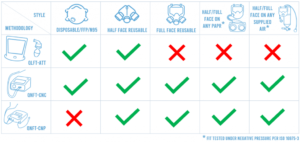
There are a number of different internationally recognised fit testing methods being either qualitative (QLFT) or Quantitative (QNFT) which are practiced in Australia and New Zealand. These different methods have pros and cons and may only be suitable for certain types of respirators as indicated further below. The three most common methodologies in Australia and New Zealand, and the ones covered under the RESP-FIT program are:
- Qualitative (QLFT) – Aerosol Taste Test (ATT) most commonly uses saccharin or Bitrex as the challenge aerosol agent. Providing the person can taste the selected challenge agent, if they can’t taste the aerosol wearing the disposable/ filtering facepiece or a half face reusable respirator fitted with a particulate filter while undertaking the set movement activities then an acceptable fit has been achieved. The methodology is only suitable for disposable/filtering facepieces and half face reusable respirators as it is determined to have an equivalent fit factor of 100. Full faces respirators require a QNFT method which can accurately determine a higher fit factor.
- Quantitative (QNFT) – Ambient aerosol condensation nuclei-counting (CNC) uses the ambient aerosols in the immediate fit testing environment to measure the amount of aerosol inward leakage getting inside the respirator compared to the amount outside the respirator. This ratio of reduction indicates the fit factor being achieved during the fit test. Different respirators types have different recommended minimum fit factors to be achieved to be deemed an adequate fit. This method can fit test all styles of tight-fitting respirators such as disposable/filtering facepieces, reusable half face and reusable full face.
- Quantitative (QNFT) – Controlled Negative Pressure (CNP) method uses the principle of ‘controlled negative pressure’ – it creates a slight negative pressure inside of the respirator being tested (while the wearer holds their breath and remains still) and monitors the pressure in order to measure any face seal leakage. This method can fit test reusable half face and reusable full-face respirator, but it is NOT suitable for disposable/filtering facepieces (FFP).
Each method has its pros, cons and limitations which workplaces should be aware when selecting a suitable methodology. Whatever methodology is selected it must be undertaken by a competent person to have confidence that an reliable indication of fit (or lack of fit) has been achieved.
AS/NZS 1715:2009 does not detail the knowledge/competencies a RPE fit tester should have. Most industries/companies currently use their own definition/level of a “competent person” but what is considered a “competent person” varies significantly. Other international fit testing standards/guidance documents detail minimum knowledge and skills a RPE fit tester should have.
No matter the tight-fitting respirator brand there must be confidence that a true indication of fit (or lack of fit) has been achieved through a validated methodology and protocol by a competent person. This competent person may be an occupational hygienist, safety professional, internal who has undertaken appropriate training or a external fit test service provider. Whoever it is, they need to be competent.
AS/NZS ISO 16975.3:2023 provides detailed guidance to the knowledge and practical skills that fit test operators should have. Below is a excerpt from AS/NZS ISO 16975.3:2023 Section 5 detailing this information as guidance. The RESP-FIT Accreditation assessment is based on these competent person requirements.
5 Competent fit-test operator
5.1 General
Fit-test operators shall be properly trained and demonstrate a proficiency in the fit-test method(s) being used. The RPD programme administrator is responsible for evaluating and verifying the training and qualification of operators. An example of an evaluation form to assess the competency of fit-test operators is given in Annex A.
NOTE Programme administrators can consider the benefits of formal training programmes from outside providers for competent fit-test operators.
5.2 Qualifications
5.2.1 General
Fit-test operators should have adequate knowledge, understanding and practical skills required to conduct a fit test. Fit-test operators shall be familiar with this document along with the appropriate sections of the RPD programme concerning RPD fit testing, purpose and applicability, specific roles and responsibilities, interference concerns, inspection, cleaning, maintenance and storage in ISO/TS 16975-1 (now adopted as SA/SNZ ISO TS 16975.1:2023) and ISO/TS 16975-2 (now adopted as SA/SNZ ISO TS 16975.2:2023).
5.2.2 Knowledge of RPD used for the fit test
Fit-test operators shall demonstrate a general knowledge of RPD used by the wearer in the workplace by:
a) a basic understanding of the selection of adequate and suitable RPD;
b) identifying RPD components and their functions;
c) demonstrating RPD inspection, cleaning, and maintenance procedures;
d) identifying different makes, models, styles, and size RPD as alternatives;
e) discussing RPD capabilities and limitations as related to RPD fit testing;
f) demonstrating and evaluating correct donning and doffing procedures including wearer-seal checks.
5.2.3 Knowledge of the fit-test method
Fit-test operators shall demonstrate knowledge and application of the fit-test method(s) being used, by:
a) explaining the purpose of fit testing;
b) explaining fit-testing procedures;
c) explaining the capabilities and limitations of the fit-test method;
d) identifying indications of erroneous fit-test results (e.g. quantitative fit factors that are unusuallylow or high);
e) demonstrating knowledge of the health and safety hazards associated with the chemicals and/or equipment used in the fit test.
5.2.4 Ability to set up and monitor the function of fit-test equipment
Fit-test operators shall demonstrate the ability to set up all applicable equipment and monitor its function for the fit-test method(s) being used, by:
a) selecting the proper RPD filters for the fit-test method;
b) preparing, inspecting and performing operational checks of fit-testing equipment and materials;
c) proper assembly and use and positioning of probes and adapters for quantitative fit-test methods;
d) identifying possible issues with the fit-test equipment.
5.2.5 Ability to conduct the fit test
Fit-test operators shall demonstrate the ability to conduct the fit test(s) being used, by:
a) properly evaluating persons being fit tested and understanding when to refuse to conduct a fit test by recognizing interference concerns (such as/ due to) facial characteristics, facial hair or other problems that may interfere with RPD fit or the fit test;
b) explaining the fit-test purpose and procedures to persons being fit tested;
c) observing that the correct donning procedure is used without assisting the person being fit tested;
d) observing that wearer-seal checks are performed according to the procedures recommended bythe RPD manufacturer;
e) observing the person being fit tested throughout the entire fit-test procedure to ensure it is performed correctly;
f) conducting the chosen fit-test method according to the procedures specified in 8.5 and 8.6;
g) evaluating and recording the results of the fit test;
h) explaining the result of the fit test and the meaning of the result to the wearer;
i)performing RPD cleaning and disinfection according to the information supplied by the manufacturer;
j) removing the fit-test adapter and reassembling valves, etc., if applicable prior to use in the workplace.
5.2.6 Ability to identify likely causes of fit-test failure
Fit-test operators shall demonstrate the ability to identify causes of fit-test failure such as:
a) improperly donned or adjusted RPD;
b) incorrectly assembled or damaged RPD;
c) incorrect size, shape or style RPD.
Reference/s for further information and detail:
- AS/NZS 1715:2009 – Selection, use and maintenance – Section 2.6 and Section 8
- SA/SNZ TS ISO 16975.1:2023 – Selection, use and maintenance – Section 7.4.1
- AS/NZS 16975.3:2023 – Fit Testing – Section 4
- RESP-FIT respfit.org.au/faqs/