

Respiratory Interface (RI) Classes
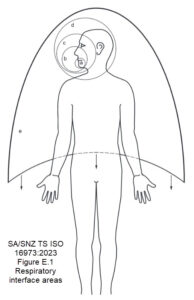
Respiratory Interface (RI) is new terminology from the AS/NZS ISO RPD Standards to describe the RPD coverage area protective barrier between the wearers respiratory system and the contaminated environment. The respiratory interface may or may not be separable from the rest of the RPD; however, it is always part of the complete RPD.
There are two types of respiratory interface: tight-fitting and loose-fitting.
- Tight-fitting (T) respiratory interfaces which rely on a good seal between the RPD and the wearers skin
- Loose-fitting (L) respiratory interfaces have a partial seal or no seal with the skin of the wearer which rely on sufficient air being provided to prevent hazardous substances leaking into the area covering the face, head or body.
Respiratory interfaces are classified by barrier lines and type, tight-fitting or loose-fitting
| SA/SNZ TS ISO 16973:2023 Table 3 Respiratory Interface (RI) classes | ||
| RI Class | RI area | Type |
|
aL |
a – Mouth only | L – Loose fitting |
|
aT |
a – Mouth only | T – Tight Fitting |
|
bL |
b – Nose and mouth | L – Loose fitting |
|
bT |
b – Nose and mouth | T – Tight Fitting |
|
cL |
c – Face | L – Loose fitting |
| cT | c – Face |
T – Tight Fitting |
| dL | d – Head |
L – Loose fitting |
| dT | d – Head |
T – Tight Fitting |
| eL | e – More than head, up to complete body |
L – Loose fitting |
| eT | e – More than head, up to complete body |
T – Tight Fitting |
Below are some examples of respiratory interfaces (RI) from SA/SNZ TS ISO 16975.1:2023
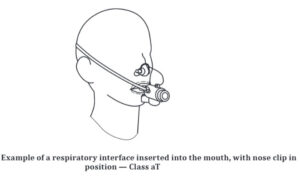
Mouth Only – Class aT
This class of tight-fitting mouth-only respiratory interface has commonly been known as a “mouthpiece” or “mouthbit”. To avoid breathing through the nose, a nose clip is necessary. In many cases, the mouthpiece is equipped with a head harness.
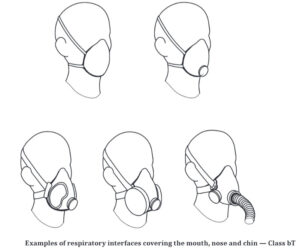
Mouth and nose – Class bT
Tight-fitting respiratory interfaces covering the mouth, nose and chin area have been commonly known as “half masks”. Tight-fitting respiratory interfaces covering the mouth and nose only have been known as “quarter masks” (not shown).
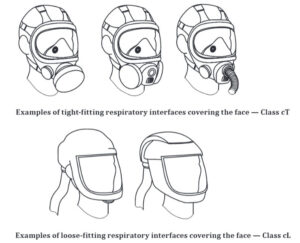
Face – Class cT & cL
Respiratory interfaces covering the entire face can be either tight-fitting or loose fitting. When the respiratory interface is tight-fitting, it is commonly known as “full face mask” or “full facepiece”. In both cases, the wearer’s eyes are protected from the contaminated environment.
Head – Class dT & dL
Respiratory interfaces covering the entire head can be either loose-fitting or tight-fitting, and have been commonly known as “hoods” or “helmet”. Hoods and helmets that are tight-fitting usually seal around the wearer’s neck.
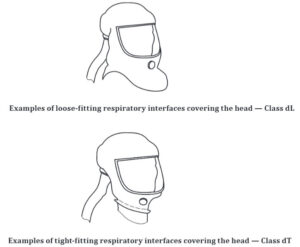
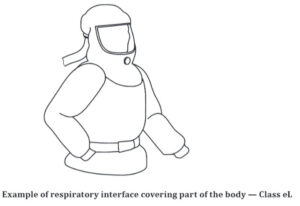
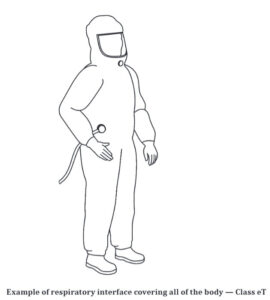
Head and part or all of the body — Class eL and Class eT
Respiratory interfaces covering the head and additional parts of the body have been commonly known as “blouses” or “suits”.
Reference/s for further information and detail:
- SA/SNZ TS ISO 16975.1:2023 – Selection, use and maintenance – Annex A.2.3
- SA/SNZ TS ISO 16973:2023 – Classification – Section 7 and Annex A